 DIMENSI
Siri Guru dan AI UNESCO (04): Lima Ciri Teras AI yang Perlu Guru Faham
Adakah AI berfikir seperti manusia? Soalan ini sering ditanya oleh guru, ibu bapa dan pekerja yang mula menggunakan alat AI setiap hari. Jawapannya penting. Jika kita salah faham cara AI berfungsi, kita mudah terlalu percaya pada jawapannya.
Ini ialah episod keempat dalam Siri Guru dan AI UNESCO. Dalam episod ini, kita melihat lima ciri teras AI yang dirujuk oleh laporan UNESCO IITE 2026 tentang rangka kerja kecekapan AI untuk guru. Lima ciri ini membantu anda memahami apa yang membezakan sistem AI daripada kecerdasan manusia.
Apa kata dokumen ini
Laporan Teacher AI Competency Frameworks: Analytical Report merujuk lima ciri teras AI daripada AI4K12 (2020). Menurut laporan ini, guru perlu memahami ciri teras tersebut supaya dapat menggunakan AI secara berkesan, bermakna dan bertanggungjawab dalam pengajaran.
Lima ciri itu ialah:
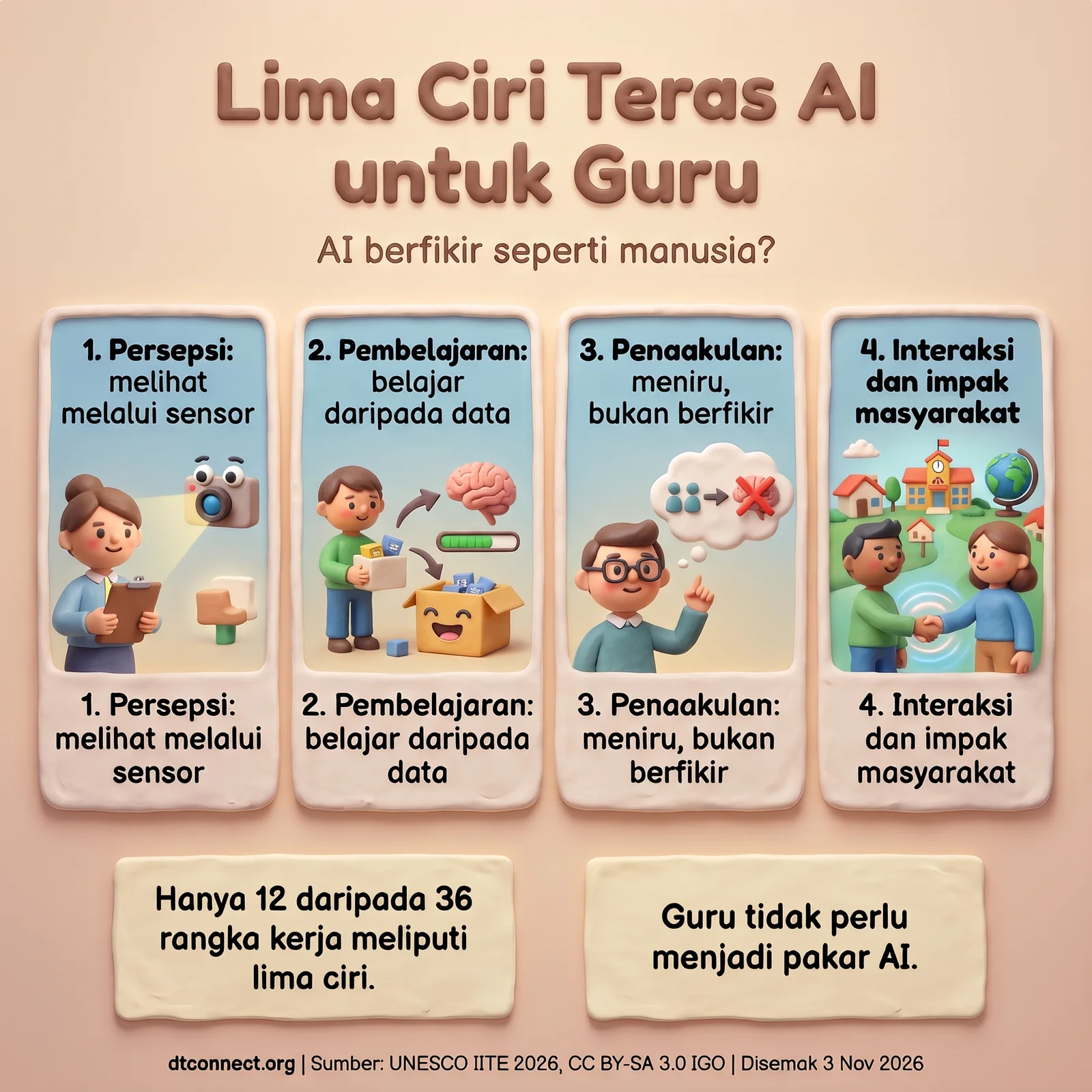
- Persepsi: komputer melihat dunia melalui sensor (alat yang mengesan cahaya, bunyi atau gerakan).
- Pembelajaran: komputer boleh belajar daripada data melalui kaedah statistik (cara mengira corak daripada banyak contoh).
- Perwakilan dan Penaakulan: komputer membina struktur data untuk mewakili maklumat dan menggunakan algoritma (langkah arahan yang tersusun) untuk menaakul. Sistem AI boleh mensimulasi (meniru) penaakulan, tetapi tidak “berfikir” seperti manusia.
- Interaksi Semula Jadi: sistem AI perlu berinteraksi dengan manusia dengan cara yang seolah-olah “manusia”. Namun, bidang ini masih mempunyai banyak had.
- Impak Masyarakat: AI boleh mempengaruhi masyarakat secara positif dan negatif.
Laporan ini turut menganalisis 36 rangka kerja (dokumen panduan kecekapan) dari pelbagai tempat. Hanya 12 daripadanya meliputi kelima-lima aspek AI.
Perkara utama
- AI boleh meniru cara menaakul, tetapi tidak berfikir seperti manusia.
- Hanya 12 daripada 36 rangka kerja yang dianalisis meliputi kelima-lima ciri teras AI.
- Empat ciri pertama agak jelas ditakrifkan. Ciri impak masyarakat pula lebih kompleks dan kurang konsisten.
- Rangka kerja Asia, contohnya China dan Korea Selatan, cenderung mengutamakan inovasi dan keselamatan. Rangka kerja UNESCO dan EU memberi perhatian lebih terperinci kepada privasi, etika dan akauntabiliti (tanggungjawab untuk menjelaskan sesuatu keputusan).
- Tidak praktikal dan tidak perlu setiap pendidik menjadi pakar AI. Keutamaannya ialah contoh penggunaan praktikal yang khusus mengikut subjek.
- Pembangunan profesional digalakkan secara kolaboratif, supaya guru dapat berkongsi amalan terbaik, contoh penggunaan dan pengalaman bilik darjah.
Apa maksudnya untuk anda
Jika anda seorang guru, anda tidak perlu menjadi jurutera AI. Anda cuma perlu faham asasnya. Lima ciri ini memberi anda bahasa yang mudah untuk menerangkan AI kepada murid. Contohnya, apabila AI memberi jawapan yang kedengaran yakin, anda boleh ingatkan murid bahawa AI meniru penaakulan dan tidak berfikir seperti manusia.
Jika anda ibu bapa atau pekerja, ciri ini membantu anda menilai hasil AI dengan lebih berhati-hati. AI belajar daripada data. Jadi, jawapannya bergantung pada data tersebut. Ciri interaksi semula jadi pula mengingatkan anda bahawa AI yang berbual seperti manusia masih mempunyai banyak had.
Laporan ini juga realistik. Ia menyatakan bahawa tidak realistik untuk mengharapkan semua guru celik AI ke tahap tinggi dalam masa singkat. Transformasi digital di sekolah mengambil masa berdekad. Namun, perancangan sistematik perlu bermula sekarang.
Cara mula mengamalkan
- Pilih satu ciri teras AI, contohnya pembelajaran daripada data.
- Cari satu contoh harian yang berkaitan dengan subjek anda.
- Bincangkan contoh itu bersama murid dalam kelas anda.
- Kongsi pengalaman tersebut dengan rakan guru supaya anda belajar bersama.
- Ulang dengan ciri lain secara berperingkat.
Perkara yang perlu diberi perhatian
Ciri impak masyarakat ialah yang paling kompleks. Laporan ini mendapati ciri ini paling kurang konsisten dalam rangka kerja yang dianalisis. Setiap negara atau organisasi memberi penekanan yang berbeza. Oleh itu, apabila anda membincangkan kesan AI terhadap masyarakat, sentuh kedua-dua sisi: kesan positif dan kesan negatif. Bincangkan juga isu seperti privasi dan etika.
Ingat juga, AI yang kelihatan “seperti manusia” tidak bermakna ia memahami seperti manusia. Semak hasil AI sebelum anda menggunakannya.
Kesimpulan
Lima ciri teras AI, iaitu persepsi, pembelajaran, perwakilan dan penaakulan, interaksi semula jadi serta impak masyarakat, memberi guru asas yang kukuh untuk memahami AI. Anda tidak perlu menjadi pakar. Mulakan dengan satu ciri, satu contoh dan satu perbincangan bersama murid anda.
Sumber
- UNESCO IITE. 2026. Teacher AI Competency Frameworks: Analytical Report. Olga Viberg (KTH Royal Institute of Technology), UNESCO IITE dan Shanghai Open University. ISBN 978-5-908199-00-1. Halaman 12 hingga 16.
- UNESCO IITE: iite.unesco.org
Diadaptasi daripada UNESCO IITE (2026), Teacher AI Competency Frameworks: Analytical Report, di bawah lesen CC BY-SA 3.0 IGO. Terjemahan dan ringkasan oleh Dimensi; bukan terjemahan rasmi UNESCO.
Ikuti siri ini: Siri Guru dan AI UNESCO: Semua Episod
Read this article in English
Does AI think like a human? Teachers, parents and workers who are starting to use AI tools every day often ask this question. The answer matters. If we misunderstand how AI works, we can easily trust its answers too much.
This is the fourth episode of the UNESCO Teachers and AI Series. In this episode, we look at five core characteristics of AI referred to in the 2026 UNESCO IITE report on AI competency frameworks for teachers. These five characteristics help you understand what distinguishes AI systems from human intelligence.
What this document says
The report Teacher AI Competency Frameworks: Analytical Report refers to five core characteristics of AI from AI4K12 (2020). According to the report, teachers need to understand these core characteristics in order to use AI effectively, meaningfully and responsibly in teaching.
The five characteristics are:
- Perception: computers see the world through sensors (devices that detect light, sound or movement).
- Learning: computers can learn from data through statistical methods (ways of calculating patterns from many examples).
- Representation and Reasoning: computers build data structures to represent information and use algorithms (ordered sets of instructions) to reason. AI systems can simulate reasoning, but they do not “think” like humans.
- Natural Interaction: AI systems need to interact with humans in ways that seem “human”. However, this field still has many limitations.
- Societal Impact: AI can affect society both positively and negatively.
The report also analysed 36 frameworks (competency guidance documents) from various places. Only 12 of them cover all five aspects of AI.
Key points
- AI can imitate reasoning, but it does not think like a human.
- Only 12 of the 36 frameworks analysed cover all five core characteristics of AI.
- The first four characteristics are fairly clearly defined. Societal impact is more complex and less consistent.
- Asian frameworks, for example China and South Korea, tend to prioritise innovation and safety. UNESCO and EU frameworks pay more detailed attention to privacy, ethics and accountability (the responsibility to explain a decision).
- It is neither practical nor necessary for every educator to become an AI expert. The priority is practical, subject-specific use cases.
- Collaborative professional development is encouraged, so that teachers can share best practices, use cases and classroom experiences.
What it means for you
If you are a teacher, you do not need to be an AI engineer. You only need to understand the basics. These five characteristics give you simple language to explain AI to your students. For example, when AI gives an answer that sounds confident, you can remind students that AI imitates reasoning and does not think like a human.
If you are a parent or worker, these characteristics help you judge AI output more carefully. AI learns from data. So its answers depend on that data. The natural interaction characteristic also reminds you that AI that chats like a human still has many limitations.
The report is also realistic. It states that it is unrealistic to expect all teachers to reach a high level of AI literacy in a short time. Digital transformation in schools takes decades. However, systematic planning needs to start now.
How to start putting it into practice
- Pick one core characteristic of AI, such as learning from data.
- Find one everyday example related to your subject.
- Discuss that example with the students in your class.
- Share the experience with fellow teachers so that you learn together.
- Repeat with the other characteristics step by step.
Things to watch out for
Societal impact is the most complex characteristic. The report found it to be the least consistent across the frameworks analysed. Each country or organisation places different emphasis on it. So when you discuss the effects of AI on society, cover both sides: the positive effects and the negative effects. Also discuss issues such as privacy and ethics.
Remember too that AI which seems “human” does not mean it understands like a human. Check AI output before you use it.
Conclusion
The five core characteristics of AI, namely perception, learning, representation and reasoning, natural interaction and societal impact, give teachers a solid foundation for understanding AI. You do not need to be an expert. Start with one characteristic, one example and one discussion with your students.
Sources
- UNESCO IITE. 2026. Teacher AI Competency Frameworks: Analytical Report. Olga Viberg (KTH Royal Institute of Technology), UNESCO IITE and Shanghai Open University. ISBN 978-5-908199-00-1. Pages 12 to 16.
- UNESCO IITE: iite.unesco.org
Adapted from UNESCO IITE (2026), Teacher AI Competency Frameworks: Analytical Report, under the CC BY-SA 3.0 IGO licence. Translation and summary by Dimensi; not an official UNESCO translation.